Henry Cowell Redwoods State Park Historic Train
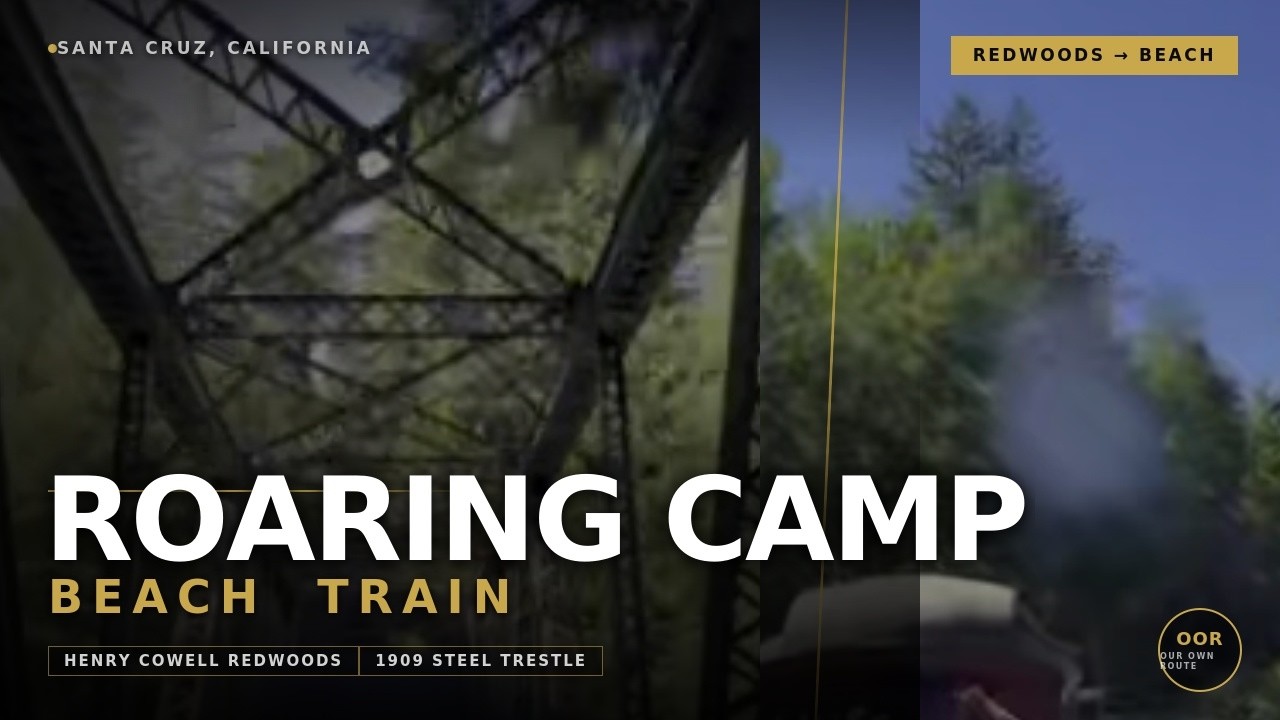
The Roaring Camp beach train through Santa Cruz's Henry Cowell Redwoods, crossing a 1909 steel trestle bridge.
About This Route
There aren't many places left in California where you can board a train in an 1880s logging town, ride an hour through old-growth redwoods and a river gorge, and step off onto a beach boardwalk. The Santa Cruz Beach Train does exactly that, on tracks that have been carrying passengers on this same route since 1875.
It leaves from Roaring Camp in Felton — a recreated 1880s logging town about six miles north of Santa Cruz, tucked against Henry Cowell Redwoods State Park. From there the line runs through the state park, drops down the San Lorenzo River Gorge, crosses a 1909 steel truss bridge, and passes through an 1875 tunnel before rolling out along the sand at the Santa Cruz Beach Boardwalk.
It's about an hour each way. What makes it worth doing isn't speed — it's that the ride is genuinely the point, not the transportation.
The Ride Itself
The character of this trip changes completely from one end to the other, and that contrast is the whole appeal.
You start in deep shade. The first stretch out of Felton runs through second-growth and old-growth redwoods with the canopy closed overhead — cool, dim, quiet enough that you hear the wheels more than anything else. Then the line follows the San Lorenzo River down its gorge, and the country opens up: water below, rock walls, sun breaking through in patches.
The tunnel is the moment everyone remembers. It's dark, it's abrupt, and it's a hundred and fifty years old. Then you're out the other side, and within a few minutes the trees have given way entirely and you're running down the middle of streets in Santa Cruz residential neighborhoods. Where friendly neighbors often wave, greet, or honk when they are nearby.
The neighborhood streets end at Depot Park where the train makes it's U-Turn rides in reverse directly into the Santa Cruz Beach Boardwalk. Passing through main street (literally through - as in right down the middle of) and the famous Santa Cruz Beach where beachgoers play volleyball and enjoy Boardwalk stores and restaurants.
Most of the cars are open-air, which means you feel the temperature change — and there is a real one. It can be fifteen or twenty degrees cooler under the redwoods in Felton than it is on the sand in Santa Cruz. Bring a layer you can take off. People routinely underdress for the Felton end or overdress for the beach end.
One expectation worth setting: the Beach Train is diesel-powered, not steam. The steam locomotives run on the separate Bear Mountain excursion (more on that below). If someone in your group is coming specifically for a steam engine, they want the other train — or both.
Schedule, Tickets & the Layover Question
Here's the part that actually determines whether your day works.
Departures from Roaring Camp: 10:00 a.m. and 2:00 p.m. Departures from the Santa Cruz Boardwalk: 12:00 p.m. and 4:00 p.m.
Important: the 4:00 p.m. train leaving Santa Cruz is one way only — there is no return trip to the beach after it. If you parked in Santa Cruz, that train strands your car. Read the schedule carefully against where you left your vehicle.
Ticket prices as of this writing: adults (13 and up) $46.59, children (2–12) $31.75, under 2 free. Verify current rates when you book.
On planning the layover: if you leave Roaring Camp at 10:00 a.m., you arrive at the Boardwalk around 11:00. Your return options are the 12:00 p.m. (which gives you roughly an hour at the beach — enough to walk around, not enough to do anything) or the 4:00 p.m. (about five hours — enough for lunch, the Boardwalk, and time on the sand). We'd take the longer one. An hour is the kind of layover that feels rushed the entire time.
You can also run the trip in reverse, starting from the beach in Santa Cruz and coming up to Roaring Camp.
Beach Train schedule and tickets — Roaring Camp Railroads
Getting There & Parking
- Address: Roaring Camp Railroads, 5401 Graham Hill Road, Felton, CA 95018. Phone (831) 335-4484.
- From San Jose: roughly 45 minutes over Highway 17, then Mt. Hermon Road to Graham Hill Road.
- Parking: Roaring Camp charges a per-vehicle parking fee separate from your ticket. Budget for it.
- Grounds access is free. You don't need a train ticket to walk around the town of Roaring Camp, and picnicking is encouraged. If part of your group isn't riding, they can still spend the day there.
- Book ahead, especially weekends, holidays, and any date with a special event running. This is not a walk-up-and-hope operation in summer.
The History — Why Any of This Exists
The name is older than the railroad. Mountain man Isaac Graham settled here in the 1830s, and Mexican authorities gave his rough settlement the name "Roaring Camp." In 1842 Graham built what's credited as the first sawmill west of the Mississippi.
Then something unusual happened: the big trees here were not cut. About twenty-five years later, this stand became the first virgin coastal redwood grove in the state to be protected from logging — which is why you're riding through old growth today rather than a stump field.
The Santa Cruz & Felton Railroad opened in 1875, hauling lumber in one direction and picnickers and tourists toward the Big Trees and the beach in the other. That dual purpose — freight and sightseeing on the same rails — has been the character of this line from day one.
The modern operation dates to 1963, when F. Norman Clark set out to preserve a working piece of 1880s California. He inaugurated steam service from Roaring Camp on April 6, 1963. Reopening the old Santa Cruz & Felton route as the Santa Cruz, Big Trees & Pacific Railway became his long project — and it killed him. Clark died of pneumonia in December 1985, contracted during the work of getting that line running again. His wife Georgiana took over as chief executive; she was later given the California Travel Industry's Lifetime Achievement Award and passed away in 2012. Their daughter Melani Clark runs the company today.
It's a family operation in the literal sense, three generations into the same stubborn idea.
The Locomotives — The Best Story on the Property
Roaring Camp owns Shay, Heisler, and Climax geared locomotives, plus diesels. Geared engines were the logging industry's answer to terrain that ordinary locomotives couldn't handle: slower, but able to pull heavy loads up brutal grades and around tight mountain curves.
A few of them have remarkable histories:
The Kahuku Baldwin (Engine #3) — the standout. Built by Baldwin Locomotive Works in Philadelphia in 1890 for a sugar plantation on Oahu, this twelve-ton narrow-gauge engine was shipped 14,000 miles around Cape Horn to reach Hawaii. It hauled cane between the Koolau Mountains and the sea from 1890 to 1947, and over that career it served under four different flags — the monarchy of King David Kalākaua, the reign of Queen Liliʻuokalani, the Republic of Hawaii, and finally the U.S. Territory of Hawaii. Retired in 1947, it was shipped again to San Francisco for museum display at the Cliff House. Clark found it there in 1966, discovered the 76-year-old engine still ran, and trucked it to Felton.
The Dixiana Shay (Engine #1) — built by Lima Locomotive Works on October 12, 1912. It worked six different short lines before coming west, picking up its name from a small mining railroad in Dixiana, Virginia. It was the first locomotive Clark acquired, and it's one of only three engines designated a National Mechanical Engineering Historical Landmark.
The Tuolumne Heisler (Engine #2) — ordered in 1899, and the last operating steam locomotive of the Old West Side Lumber Company. Roaring Camp rescued it from the scrap heap in 1962 for $7,000.
The Sonora Shay (Engine #7) — built 1911, and one of only 83 Shays left in North America.
The Other Train — Redwood Forest Steam Train
If you're making the drive, know that Roaring Camp runs two entirely different excursions from the same depot.
The Redwood Forest Steam Train is the narrow-gauge one: 3-foot gauge track, steam locomotives dating to the 1890s, open-air cars, about 75 minutes round trip, climbing 3.25 miles up Bear Mountain through the Welch Big Trees Grove with a conductor narrating along the way. Passengers can get off at the summit and stand in the redwoods before heading back down.
The grades on this line reach around 8% — described by the railroad as the steepest in western America — which is exactly why geared locomotives are the engines that work here.
Different train, different track gauge, different power, different experience. If you have a full day, do both. If you have half a day and want steam and redwoods, do this one. If you want the journey and the ocean at the end of it, do the Beach Train.
Redwood Forest Steam Train details · Roaring Camp Railroads home
Practical Notes
- Dress in layers. Genuinely the single most useful tip for this ride.
- Open-air cars mean weather. Fog, sun, and wind all reach you. Sunscreen for the beach end; something warm for Felton.
- Restrooms are at Roaring Camp and at the Boardwalk, not on board.
- Food: there are food options at Roaring Camp, and obviously no shortage at the Boardwalk. Picnicking on the Roaring Camp grounds is welcome.
- Kids do well on this. The ride is long enough to matter and short enough not to strain. Under 2 rides free.
- Special events run constantly — Thomas the Tank Engine weekends, Holiday Lights trains, dinner trains, harvest fairs, steam festivals. Check the events calendar before you pick a date, either to catch one or to avoid the crowds one brings.
- Confirm the schedule before you drive out. Beach Train service has been interrupted in the past for track and infrastructure work, and schedules shift seasonally.
Check out our gear list – These are items we use regularly, some we even review for you!
Sources & Reference Links
- Roaring Camp — Santa Cruz Beach Train (schedule, pricing, route features): https://roaringcamp.com/excursions/santa-cruz-beach-train-2
- Roaring Camp — History (Isaac Graham, Clark family, all locomotive histories): https://roaringcamp.com/historical-facts/
- Roaring Camp — Redwood Forest Steam Train: https://roaringcamp.com/excursions/redwood-forest-steam-train
- Trains Magazine — Roaring Camp Railroads profile (fleet, 75-minute excursion, grounds): https://www.trains.com/trn/railroads/tourist/roaring-camp-railroads-profile/
- Wikipedia — Roaring Camp & Big Trees Narrow Gauge Railroad (3-ft gauge, 3.25 miles): https://en.wikipedia.org/wiki/Roaring_Camp_%26_Big_Trees_Narrow_Gauge_Railroad
- Wikipedia — Santa Cruz, Big Trees and Pacific Railway (gauge conversion, line history): https://en.wikipedia.org/wiki/Santa_Cruz,_Big_Trees_and_Pacific_Railway